By Bryan Crabtree
For years, one phrase has dominated nearly every discussion about America's housing market: we don't have enough homes. Politicians, economists, housing advocates, and industry organizations routinely point to a housing shortage as the primary reason homeownership has slipped further out of reach for millions of Americans. Their argument is rooted in history. After the financial crisis of 2008, homebuilding collapsed, builders left the industry, financing tightened, and the nation spent more than a decade constructing fewer homes than population growth would normally require.
There is truth in that narrative. The United States almost certainly underbuilt housing after the Great Recession, and that decision has had lasting consequences. Millions of homes that likely would have been built under normal economic conditions simply never materialized. It is difficult to argue otherwise.
But acknowledging that history does not mean it fully explains today's market.
In fact, I believe we have reached a point where the constant focus on a "housing shortage" has become an oversimplification that prevents us from understanding what is actually happening. The market we see today is no longer driven solely by a lack of supply. It is increasingly driven by a collapse in affordability, and those are two very different problems.
The distinction matters because the solutions are not the same.
One of the easiest ways to test the traditional shortage narrative is to look at what is happening across much of the country today. If America truly suffered from an overwhelming shortage of homes, we would expect prices to continue climbing almost everywhere. We would expect bidding wars to remain commonplace, inventory to disappear quickly, and buyers to compete aggressively for nearly every listing.
Instead, we are seeing something very different.
In metro after metro, inventory has increased. Homes are sitting on the market longer. Price reductions have become routine instead of unusual. Sellers who once expected multiple offers in a weekend are learning that buyers have become far more selective and far less willing to stretch financially.
That is not what a severe shortage looks like.
The reason is simple: housing supply cannot be measured in isolation. It only has meaning when compared with demand. A market with 10,000 available homes may have a shortage if 20,000 qualified buyers are actively competing for them. The very same market can suddenly appear oversupplied if only 5,000 buyers can actually afford to purchase those homes.
Demand has changed dramatically.
For much of the last decade—and especially during the pandemic—the housing market became one of the largest fear-of-missing-out events in modern financial history. Interest rates hovered near historic lows. Money was extraordinarily cheap. Government stimulus flooded the economy. The Federal Reserve's monetary policies encouraged borrowing, while a widespread belief took hold that home prices could only move in one direction.
Americans responded exactly as many people do when they believe something valuable is becoming scarce.
They bought.
They upgraded sooner than they otherwise would have.
They purchased vacation homes.
They accumulated investment properties.
They converted houses into short-term rentals.
Institutional investors acquired entire neighborhoods of single-family homes.
Many buyers stretched well beyond what previous generations would have considered financially prudent because monthly payments remained manageable at three percent mortgage rates.
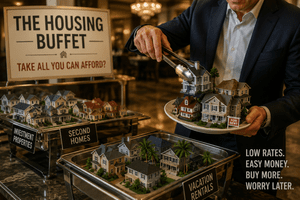
The housing market became something of an all-you-can-eat buffet. People loaded their plates because they feared the opportunity would disappear if they waited.
Government created many of those conditions. Ultra-low interest rates, unprecedented fiscal stimulus, and years of policies that rewarded asset appreciation fueled one of the strongest housing booms in American history.
But government is only part of the story.
Consumers also made choices.
Millions voluntarily waived inspections, paid far above asking price, ignored traditional valuation metrics, and assumed historically low borrowing costs would continue indefinitely. Personal responsibility did not disappear simply because public policy encouraged risk-taking.
Today, the consequences of those decisions have become painfully visible.
Mortgage rates approaching seven percent did not suddenly make housing expensive. They revealed just how expensive housing had already become. A home purchased at today's prices with yesterday's interest rates produced one monthly payment. The same home financed at today's rates produces an entirely different financial reality.
Higher interest rates have collided with rapidly increasing insurance premiums, higher property taxes, escalating maintenance costs, rising HOA dues, and inflation across nearly every household expense. For many families, the monthly cost of owning a home has simply exceeded what their income will support.
That is why buyer demand has weakened.
It is not because Americans suddenly lost their desire to own homes. It is because millions can no longer justify—or qualify for—the cost of ownership.
This distinction becomes particularly important when examining markets like Charleston.
National headlines often paint housing with a broad brush, but Charleston has never been a single housing market. Mount Pleasant behaves differently than Summerville. Downtown Charleston operates under different economic forces than Cane Bay, Nexton, Moncks Corner, or Goose Creek.
Mount Pleasant continues benefiting from limited land availability, relatively high household incomes, and continued migration from wealthier regions of the country. Well-prepared homes in desirable neighborhoods continue to attract buyers, although even this market has become noticeably more price sensitive than it was two years ago.
Charleston's historic peninsula and luxury waterfront communities continue to experience demand that exceeds much of the country, but even those markets have seen longer marketing times and greater negotiation than during the height of the pandemic boom.
Summerville tells a different story altogether.
Over the past several years, builders have added thousands of homes throughout Berkeley and Dorchester Counties. New construction communities continue competing aggressively for buyers by offering mortgage rate buy-downs, closing cost assistance, and other financial incentives that would have been almost unimaginable during the frenzy of 2021.
If America suffered from nothing more than an overwhelming shortage of housing, these incentives would not exist.
Builders would not need to negotiate.
Price reductions would remain rare.
Inventory would disappear.
Instead, many communities now have sufficient inventory for today's level of qualified demand. The challenge is that today's qualified demand looks very different than it did when mortgage rates were half of what they are now.
That reality also explains why simply building more homes, while important over the long term, will not by itself restore affordability.
America absolutely needs additional housing. The underbuilding that followed the 2008 financial crisis created real structural issues, particularly in affordable housing. Communities still need workforce housing, starter homes, and attainable rental options. Teachers, nurses, first responders, and young families deserve opportunities to live in the communities they serve.
But increasing supply alone will not solve the affordability problem if financing remains prohibitively expensive, insurance continues climbing, taxes increase, and overall ownership costs remain disconnected from household incomes.
Housing affordability depends on far more than the number of homes standing on a street.
It depends on whether ordinary Americans can realistically afford to buy them.
That requires responsible monetary policy, fiscal discipline that helps reduce inflationary pressures, local governments willing to address unnecessary regulatory costs, insurance markets that remain functional, and a renewed focus on housing as shelter rather than simply another financial asset.
Somewhere along the way, America stopped viewing homes primarily as places to raise families and began viewing them as investment vehicles expected to deliver outsized financial returns. When housing becomes first and foremost a speculative asset, affordability inevitably becomes a secondary concern.
The irony is that both sides of today's debate are partially correct.
Those who argue we underbuilt after 2008 are right.
Those who point to high interest rates and inflation are right.
But neither explanation, standing alone, fully captures where we are today.
The housing crisis has evolved.
In 2026, America does not simply face a shortage of homes. It faces a shortage of affordability. Those are not interchangeable concepts, and confusing one for the other risks producing policies that solve yesterday's problem instead of today's.
Until we recognize that supply only matters relative to demand—and that demand is ultimately determined by affordability—we will continue debating housing through an incomplete lens.
The market has changed.
Perhaps it's time the conversation changed with it as well.
About Bryan Crabtree
Bryan Crabtree is a luxury real estate broker with IndigoOak | Christie's International Real Estate, serving Charleston, Mount Pleasant, Summerville, and the South Carolina Lowcountry. With nearly three decades of experience, more than $1 billion in career sales, and over 5,000 real estate transactions, Bryan is known for combining local market expertise with data-driven analysis to help buyers, sellers, and investors make informed decisions. Through his articles, podcasts, and market commentary, he explores the economic forces shaping real estate—from affordability and mortgage rates to housing policy and local market trends—providing practical insights that go beyond the headlines.