by Bryan Crabtree
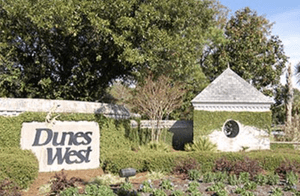
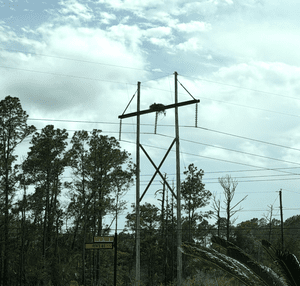
I’m sick of bad corporate citizens. My wife and I got Birds of Prey involved in saving the Osprey nests by the Club at Dunes West and Hwy 41 at the back gate of Dunes West. Birds of Prey offered to build platforms to safely relocate the nests and days later Dominion eradicated them and destroyed them. Whether they did it legally or not is one subject worth discussing. What we know is that they acted swiftly and ‘snubbed their nose’ at Birds of Prey’s offer.
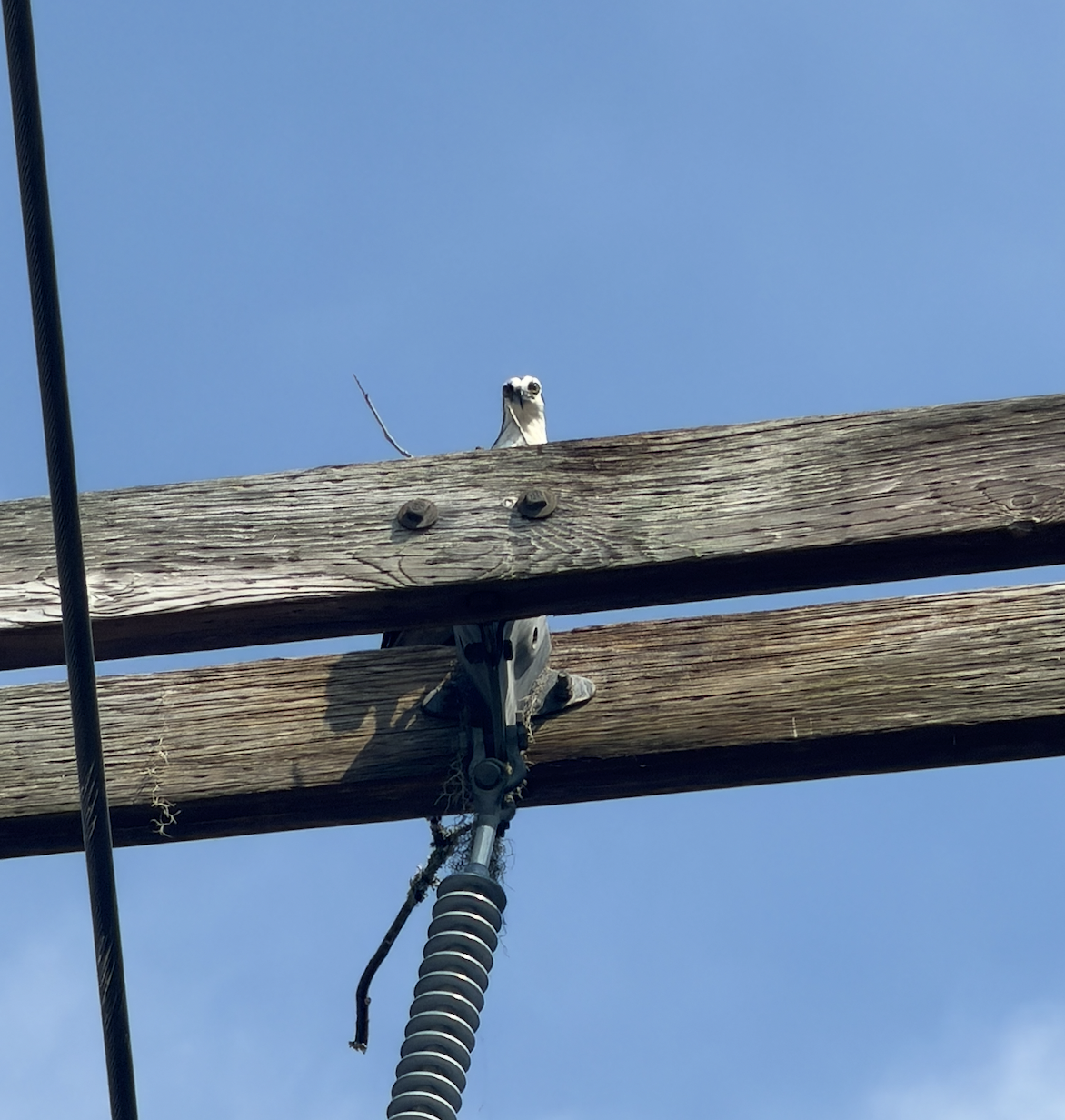
(Above) Osprey sitting on Hwy 41 next to his nest after Dominion destroyed it.
That’s unacceptable. Shame on you Dominion Energy!
I believe something deeply troubling is happening across the Lowcountry as development, construction and utility expansion collide with the wildlife that was here long before any of us. Too often, developers, builders and powerful utilities win that collision, while the public gets some version of the same answer afterward: everything was done properly, the appropriate people were consulted, and “protocol was followed.”
Maybe I'm wrong about what recently happened with an osprey nest in Dunes West. If Dominion Energy can produce documentation demonstrating that the nest was legally removed, properly determined to be inactive and all applicable wildlife laws were followed, I will publicly apologize.
But they need to show us.
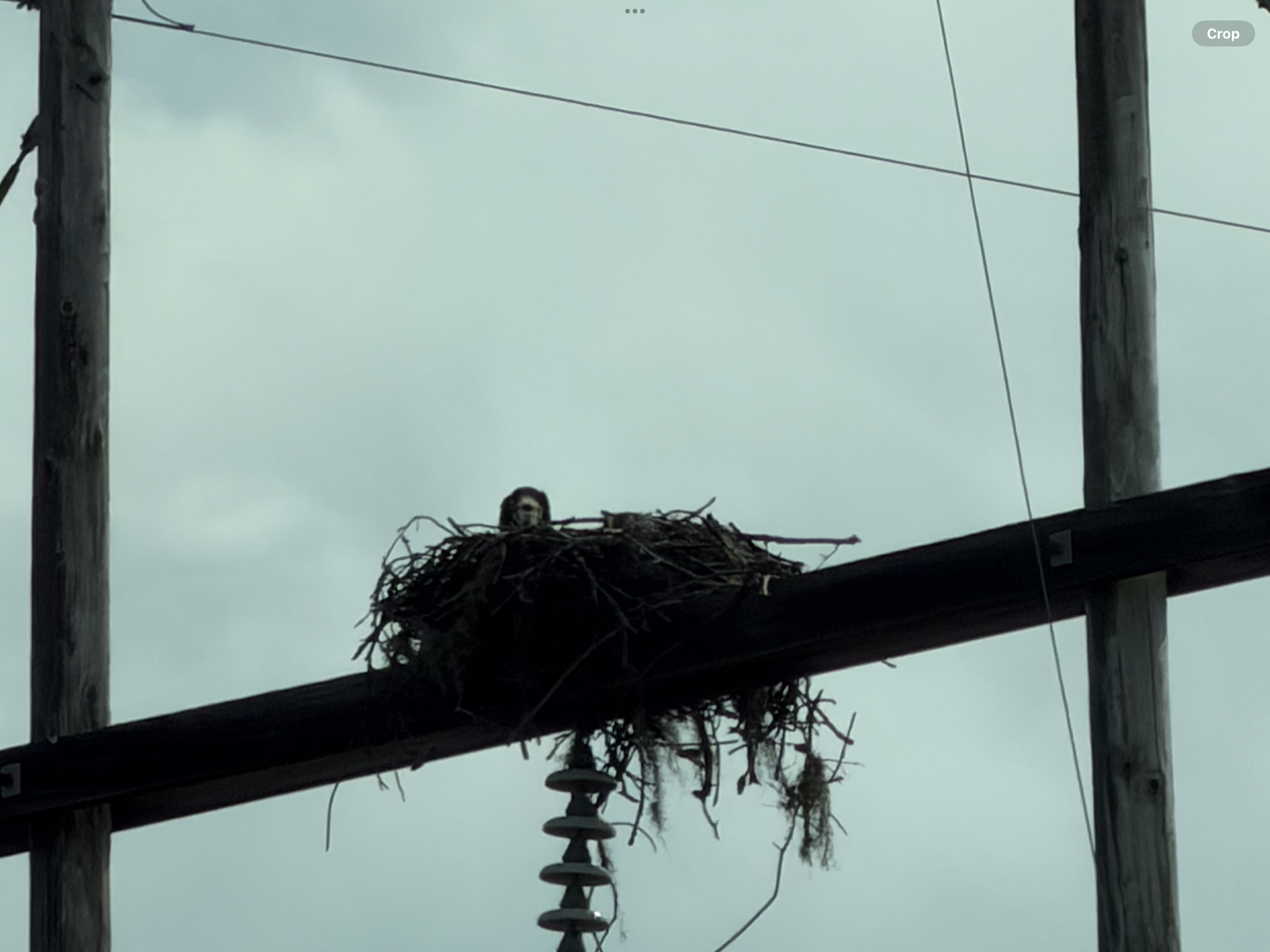
Above - the picture of the next I took within 48 hours of Dominion Energy destroying it even though Birds of Prey contacted them willing to relocate it.
I personally photographed an osprey sitting in this nest approximately two days before it was removed. The photograph doesn't tell me whether eggs or chicks were inside, and I won't pretend that it does. But there was unquestionably an osprey sitting in the nest shortly before it disappeared.
We contacted the Center for Birds of Prey because we wanted the birds protected and, if necessary, safely relocated or provided an alternative nesting location. As soon as the Center for Birds of Prey became involved and Dominion was contacted, the response we effectively got from Dominion was: nothing to see here. No worries. The nest isn't active.
Then the nest was destroyed.
That's when my suspicions went through the roof.
I'll disclose my bias upfront: I already dislike Dominion Energy. I believe Dominion has been in bed with politicians in South Carolina for a very long time, and I believe this powerful monopoly has repeatedly been allowed to run all over the citizens of this state. That's my opinion, and I'm not going to sanitize it because Dominion is a massive corporation with a public-relations department and lawyers.
But my dislike of Dominion doesn't make them guilty of violating wildlife laws in this instance. That's why I'm giving them a simple opportunity to prove my suspicions wrong. Post the proof. Show us when the nest was inspected, who inspected it, what they found and how they concluded it wasn't active when I have a photograph of an osprey sitting in it roughly two days before it was destroyed.
People have asked questions. Instead of publicly producing the photographs, inspection reports, correspondence or other documentation that could put this controversy to rest, Dominion appears to have gone silent.
Silence isn't legal proof of guilt. But when people are asking legitimate questions and you possess evidence that could answer them, silence certainly looks guilty to me. It makes my suspicions stronger, not weaker.
And Dominion isn't the only reason I'm angry.
In another controversy circulating widely on Lowcountry social media in late July, video reportedly documented the destruction of multiple barn swallow nests at an apartment property. The controversy went further: according to the accounts circulating with the footage, the woman who reported what happened was subsequently threatened with or subjected to an effort to pursue charges against her. A Facebook post indexed from July 21, 2026, for example, alleges that an active barn swallow nest at an apartment complex in Charleston was destroyed by maintenance personnel.
I find the entire episode disgusting. And it illustrates why the public needs to pay attention.
Barn swallows aren't disposable construction debris. They are migratory birds protected under federal law. The Migratory Bird Treaty Act has existed since 1918 and protects migratory birds from unlawful taking. Whether a particular nest may legally be removed depends critically upon circumstances such as whether eggs or dependent young are present and whether applicable authorization exists.
That distinction matters. It is also why I don't accept “our people checked it” as sufficient when credible questions arise.
Developers know construction schedules months or years in advance. Utilities know when major poles need replacement. These aren't mom-and-pop operations surprised by a bird on Tuesday morning. They employ engineers, attorneys, environmental consultants, contractors and project managers. Wildlife conflicts can and should be anticipated before an active nesting season collides with a construction deadline.
Ospreys are an iconic part of coastal South Carolina. These fish-eating raptors commonly build large nests on trees, channel markers, utility poles and other elevated structures, and they frequently return to and repair existing nesting sites. Their populations were devastated during the twentieth century, particularly by pesticides such as DDT, before making a remarkable recovery.
Charleston also has the Center for Birds of Prey practically in our backyard. These organizations exist because birds of prey matter. Raptors occupy an important position in our ecosystem, and the health of bird populations can tell us something about the health of the environment around us.
Yet we continue watching the Lowcountry get stripped away piece by piece.
I have watched forests become subdivisions, open land become apartment complexes, utility corridors expand and thousands upon thousands of homes appear. I'm a real estate broker. I understand that people need homes and that Charleston needs infrastructure. I'm not anti-growth or anti-development.
I'm against bad corporate citizenship.
Development doesn't give us permission to annihilate everything that gets in our way.
What worries me most is what happens when nobody is watching. An active nest delaying construction costs somebody money. Altering a utility project costs money. Waiting until nesting season ends costs money. Building an alternative osprey platform costs money.
Those incentives don't prove anyone violated the law. But pretending those incentives don't exist is ridiculous. They are precisely why transparency and enforcement matter.
And we've reached a point where I don't think the public should blindly accept corporate assurances anymore.
If multiple swallow nests were legally removed, show us why. If they were inspected, produce the inspection. If wildlife officials were consulted, show the correspondence. If permits were required and obtained, show them.
I want exactly the same thing from Dominion.
Tell us who inspected this osprey nest and when. Tell us what criteria were used to determine it was inactive. Tell us whether eggs or chicks were specifically ruled out. Tell us whether photographs were taken. Tell us whether the South Carolina Department of Natural Resources, U.S. Fish and Wildlife Service or another wildlife authority was involved.
Most importantly, release the contemporaneous evidence showing the condition of this nest immediately before it was destroyed.
I am perfectly willing to be wrong.
If Dominion produces credible documentation demonstrating that the nest was legally removed and every applicable wildlife requirement was followed, I will publicly say I was wrong and apologize.
What I won't do is accept “trust us.”
We are gradually destroying many of the very things that made the Lowcountry special enough for people to want to live here in the first place. We market Charleston with marshes, live oaks, waterways, dolphins, shorebirds and spectacular natural beauty while simultaneously clearing and developing more and more of the environment that sustains them.
There has to be a balance.
And being a good corporate citizen means more than satisfying the minimum requirements and then telling everyone to go away. It means transparency when the community has legitimate concerns.
An osprey was sitting in this nest approximately two days before it disappeared. We contacted people whose mission is protecting birds. Dominion was contacted. We were essentially told there was nothing to worry about because the nest wasn't active.
Then the nest was gone.
I don't buy it. But I'm giving Dominion every opportunity to prove that I should. Post the proof.
About Bryan Crabtree
Bryan Crabtree is a Charleston-based real estate broker, housing market analyst, and consumer advocate with nearly 30 years of experience helping buyers and sellers navigate one of the country's most dynamic real estate markets. Over the course of his career, he has participated in more than 5,500 real estate transactions totaling over $1 billion in sales and has built, led, and scaled successful real estate companies while earning recognition among the top 1% of agents nationwide.
Beyond real estate, Bryan is known for his independent commentary on housing, growth, development, government policy, and issues affecting the South Carolina Lowcountry. His writing reflects a belief that economic growth should never come at the expense of transparency, accountability, private property rights, or responsible stewardship of the communities and natural resources that make Charleston unique. Whether writing about housing affordability, overdevelopment, infrastructure, environmental concerns, or public policy, Bryan approaches each issue with extensive market knowledge and a willingness to challenge powerful institutions when he believes the public deserves answers.
Bryan is affiliated with IndigoOak | Christie's International Real Estate and publishes housing market analysis, investigative opinion pieces, and consumer-focused real estate resources through TheRealEstateExperts.com, where his mission is simple: provide honest information, ask difficult questions, and help people make better decisions about real estate and the future of the Lowcountry.