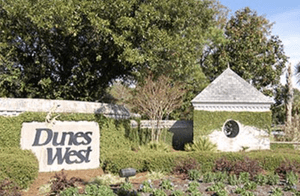
In recent months, the conversation around the growing deer population in Dunes West has intensified. Reports suggest the herd has expanded dramatically—rising from just a few dozen deer a decade ago to nearly 1,000 today. Concerns about safety, landscaping damage, and ecological imbalance are valid, and they deserve thoughtful discussion.
But there’s another side to this conversation—one that risks being overlooked in the urgency to “solve” the issue.
Because the truth is this: the presence of wildlife, including deer, is not a flaw in Dunes West—it’s one of its defining strengths.
A Community Designed Around Nature
What many people forget—or may not even realize—is that Dunes West wasn’t built like many of today’s high-density developments.
It was envisioned and developed decades ago, at a time when land preservation was still a central philosophy of community planning.
That vision left a lasting imprint:
Hundreds of acres of preserved marsh, wooded areas, and open fields
Natural buffers between neighborhoods
A layout that works with the land—not against it
And that matters.
Because when you preserve that much natural space, you don’t just create beauty—you create habitat.
Dunes West didn’t accidentally attract wildlife. It was built in a way that naturally supports it.
The deer population we’re seeing today is, in many ways, a direct result of that original vision.
A Community Unlike Any Other in Mount Pleasant
Dunes West has always stood apart from other neighborhoods in the Charleston area. It’s not just the golf course, the amenities, or the architecture—it’s the environment.
This is a community where:
You see deer walking through the marsh at sunrise
Egrets and herons line the water’s edge
Fish jump in the creeks behind homes
Tree-lined streets feel connected to nature—not carved out of it
That’s not an accident. That’s intentional design meeting long-term environmental reality.
And the deer? They’re part of that story.
The Reality: Yes, There Are More Deer
Let’s be clear—this isn’t about ignoring the data.
There are more deer in Dunes West today than there were 10 years ago. Residents are seeing:
Increased road crossings
More aggressive feeding behavior
Damage to landscaping
Greater visibility in previously uncommon areas
Biologists point to familiar causes:
Fewer natural predators
Human feeding (intentional or not)
Expanding development pushing wildlife into concentrated areas
But layered on top of that is something unique to Dunes West:
There is simply more preserved, livable habitat here than in most communities in the region.
That’s not the problem. That’s the foundation.
The Risk of Overcorrecting
One of the proposed solutions is culling the herd—hiring sharpshooters to reduce the population.
And while that may seem like a quick fix, it raises important concerns:
It treats the symptom, not the cause
Deer populations can rebound quickly if underlying conditions remain
It fundamentally alters the character of the neighborhood
More importantly, it introduces a philosophical question:
At what point does a nature-driven community start engineering nature out of itself?
Because once that line is crossed, it’s hard to go back.
The Bigger Picture: Development vs. Balance
What’s happening in Dunes West isn’t isolated. It’s part of a broader trend across Mount Pleasant and the Charleston region.
As development expands:
Natural habitats shrink
Wildlife corridors are disrupted
Animals adapt—and often concentrate in remaining green spaces
Dunes West, because of its preserved land and original design philosophy, becomes a refuge.
So in many ways, the deer population isn’t just a “Dunes West problem.”
It’s a reflection of what happens when one community preserves nature while others build over it.
Living With Wildlife—Not Just Around It
There’s a difference between unmanaged growth and thoughtful coexistence.
Instead of rushing toward extreme solutions, there are practical approaches that deserve more attention:
Strong enforcement against feeding wildlife
Smarter landscaping strategies
Traffic calming and signage in high-crossing zones
Collaboration with wildlife experts on long-term population management
Continued protection of the very green spaces that define the community
These aren’t as immediate as culling—but they’re more aligned with preserving what makes Dunes West special.
Why This Matters More Than People Think
For buyers—and especially for those considering Dunes West—this conversation goes deeper than deer.
It speaks to what kind of community this is.
There are plenty of neighborhoods in the Charleston area where:
Wildlife is minimal
Landscapes are tightly controlled
The environment feels more suburban than coastal
Dunes West is not that.
And for many homeowners, that’s exactly the point.
The deer, the marsh, the trees, the unpredictability of nature—those aren’t inconveniences.
They’re part of the lifestyle.
Final Thought: Protect the Vision, Not Just the Numbers
Yes, the deer population needs to be addressed. Ignoring it isn’t realistic.
But it’s worth remembering why they’re here in the first place.
They’re here because decades ago, Dunes West was designed differently—
with preservation, space, and nature at the forefront.
That decision created one of the most beautiful and unique communities in Mount Pleasant.
And now the challenge isn’t just managing deer.
It’s making sure that in solving today’s problem,
we don’t erase the very vision that made Dunes West what it is.
About Bryan Crabtree
Bryan Crabtree is a longtime Dunes West resident and Charleston real estate expert with over 27 years of experience and more than 5,500 homes sold. Having personally sold over 200 homes in Dunes West, Bryan offers unmatched, firsthand knowledge of the community—from its early development to its current evolution. His deep local expertise, combined with advanced AI-driven marketing and global exposure through Christie’s International Real Estate, allows him to position homes in Dunes West in a way that no outside agent can replicate.